Commercial Flooring Installation

Why Flooring Failures Often Begin Long Before Installation

Introduction:

On many construction projects,  commercial flooring installation appears to be one of the final steps before a building is ready for occupancy. The walls are painted, ceilings are complete, and lighting is installed. From the outside, everything looks ready.

But beneath that moment lies a critical question that isn’t always visible:

Are the conditions inside the building actually ready for flooring?

For many owners and project teams, the reality is that flooring failures rarely begin during installation. Instead, the root cause often starts weeks earlier, when environmental conditions inside the building fluctuate beyond the tolerances required for adhesives, materials, and subfloors.

Temperature changes. Excess moisture. Relative humidity spikes.

These conditions can quietly affect flooring systems long before the first plank, tile, or sheet is installed.

Understanding and monitoring these factors has become an increasingly important part of delivering reliable flooring performance.

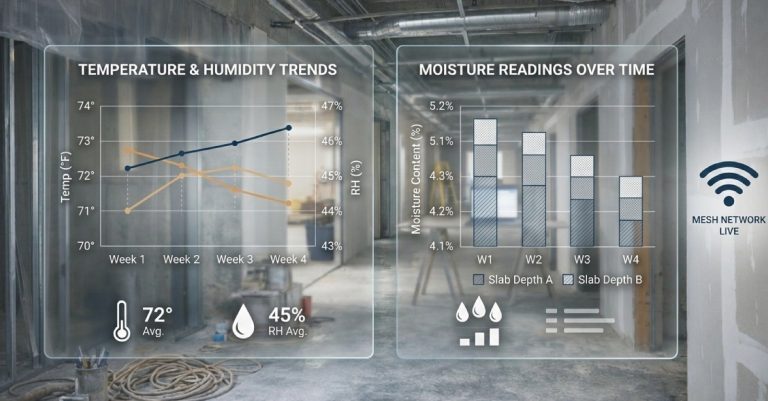
Flooring failures rarely start on installation day — they often begin weeks earlier with unnoticed changes in temperature, humidity, and moisture.

A Common Scenario on Active Jobsites

Imagine a project nearing completion.

The building envelope is closed, and interior trades are wrapping up their work. Flooring installation is scheduled for the following week, and everything appears to be on track.

But over the weekend, temperatures inside the building drop significantly. At the same time, humidity levels rise due to incomplete HVAC balancing and recent weather changes.

When installers arrive on Monday morning, the jobsite may look ready, but the environment may not meet the conditions required for adhesives and flooring materials.

This is where problems can begin.

Many flooring systems rely on specific temperature and moisture tolerances to perform correctly. If installation occurs outside of these conditions, materials can shrink, expand, or fail to bond properly to the subfloor. Over time, this can lead to issues such as curling, adhesive failure, or premature wear.

The difficult part is that these conditions are not always obvious at first glance.

Without proper monitoring, teams may not realize that the environment has moved outside acceptable ranges until long after installation is complete.

Why Jobsite Conditions Matter So Much

Flooring systems today are highly engineered products. Manufacturers carefully specify the environmental conditions required for their materials to perform as intended.

These specifications often include:

  • Ambient temperature ranges
  • Relative humidity limits
  • Concrete slab moisture levels
  • Acclimation periods for flooring materials

If any of these factors fall outside the recommended tolerances, the risk of flooring failure increases significantly.

Temperature and humidity fluctuations can directly affect both the materials and the adhesives used during installation. For example, excessive moisture can interfere with adhesive curing or cause dimensional changes in flooring materials. Over time, these changes can lead to movement, shrinkage, or delamination.

Because of these risks, maintaining the correct environmental conditions is not simply a best practice—it is often a requirement for maintaining manufacturer warranties.

For building owners, this highlights an important reality: flooring performance is closely tied to environmental control during construction.

A jobsite may look ready for flooring, but the environment must also meet the tolerances required for materials and adhesives to perform.

The Challenge of Monitoring Conditions

Historically, monitoring jobsite conditions has relied on periodic manual checks.

A project manager or installer might visit the site, measure temperature and humidity with handheld tools, record the readings, and return later to check again.

While helpful, this method has limitations.

Conditions inside a building can change quickly. A measurement taken in the morning may look acceptable, but humidity could rise significantly overnight. Temperature may fluctuate after HVAC systems shut down or after exterior weather changes.

Without continuous monitoring, it can be difficult to understand how conditions evolve over time.

This challenge has led to the growing use of remote environmental monitoring technology on construction projects.

How Remote Jobsite Monitoring Helps

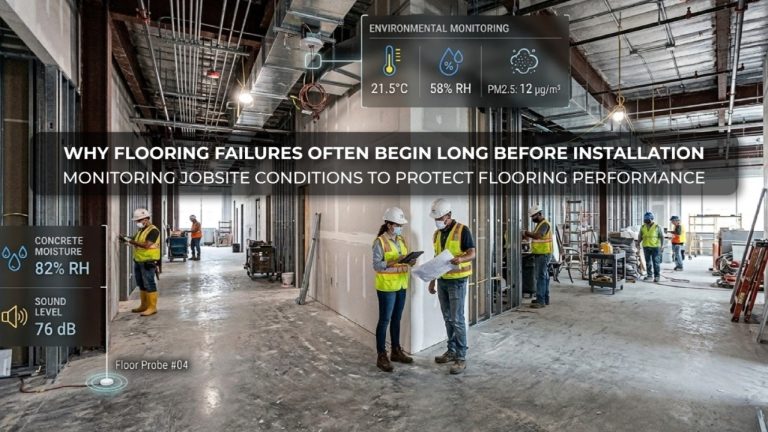
Modern monitoring platforms such as systems originally developed under the name CLiMIT use connected sensors placed throughout the jobsite to track environmental conditions in real time.

These sensors continuously monitor key variables such as temperature, humidity, and moisture levels and transmit that data to cloud-based software that can be accessed from a mobile device or computer.

Instead of relying on occasional manual checks, project teams can view live readings and historical trends for the jobsite environment.

In practical terms, this offers several advantages.

First, it provides constant visibility into jobsite conditions. Sensors can track changes in the environment 24 hours a day, allowing teams to understand how temperature and humidity fluctuate during evenings, weekends, or weather changes.

Second, the data can be compared directly with manufacturer specifications. Some monitoring platforms maintain databases of product requirements, allowing teams to confirm whether the jobsite environment is within acceptable tolerances before installation begins.

Third, the system can generate reports and alerts. If conditions move outside the acceptable range, teams can receive notifications and take corrective action before installation proceeds.

This proactive approach helps teams avoid installing materials under unsuitable conditions, one of the most common causes of flooring failure.

Turning Data Into Better Project Decisions

Beyond monitoring, one of the most valuable aspects of jobsite condition technology is documentation.

Environmental monitoring systems store detailed records of temperature, humidity, and moisture conditions throughout the life of a project. These records can be compiled into reports that document conditions before, during, and after installation.

For building owners, this provides a transparent record of how environmental conditions were managed during construction.

For project teams, it provides an additional layer of accountability and quality assurance.

Perhaps most importantly, it allows decisions to be based on real data rather than assumptions.

Instead of asking, “Do we think the building is ready for flooring?” teams can ask a more precise question: Are the conditions actually within specification?

When environmental conditions are monitored continuously, installation decisions can be based on data rather than assumptions.

A More Proactive Approach to Flooring Performance

As construction technology continues to evolve, many project teams are moving toward more proactive approaches to quality control.

Environmental monitoring tools help bridge the gap between construction progress and material performance. They provide continuous insight into the conditions that influence flooring installation and long-term durability.

For building owners, this shift represents a meaningful improvement in how flooring systems are protected during construction.

By identifying environmental risks early before installation occurs – teams can avoid costly repairs, project delays, and warranty disputes later on.

Where Axis Fits Into This Process

At Axis Interior Systems, technologies like CLiMIT are used selectively on projects where monitoring jobsite conditions adds meaningful value to the installation process.

Not every project requires advanced environmental monitoring. However, in situations where temperature, humidity, or moisture conditions may fluctuate, tools like these can help ensure that flooring systems are installed within the tolerances specified by manufacturers.

This approach allows project teams to make informed decisions about when conditions are suitable for installation, helping protect both material performance and manufacturer warranties.

As part of our broader commitment to quality and performance, Axis evaluates project conditions carefully and recommends monitoring solutions when they support better outcomes for clients and building owners.

To learn more about our approach to flooring installation and project quality assurance, explore our commercial flooring services.

By combining experienced installation practices with data-driven quality checks, the goal remains simple: Ensure that flooring systems perform as intended for years to come.

Explore More Flooring Insights

Discover additional insights on commercial flooring systems, installation methods, and performance considerations across various industries.

Copyright © 2026 IPRS Consultants. - All rights reserved.

Copyright © 2026 IPRS Consultants. - All rights reserved.

Scroll to Top