
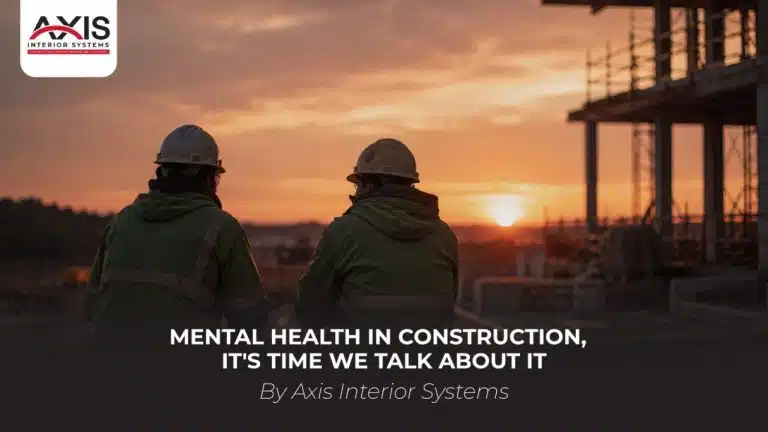
Mental Health in Construction: It's Time We Talk About It
Introduction
There is something that does not get said enough in our industry.
Construction workers build the spaces where people live, work, learn, heal, and gather. They pour the foundations, frame the walls, and finish the floors of every building that makes modern life possible. And too many of them are doing it while quietly carrying a weight that nobody on the jobsite ever asks about.
Mental health in construction is a crisis. And at Axis Interior Systems, we believe it is time for companies like ours to say that out loud.
What the Data Tells Us
The Construction Industry Alliance for Suicide Prevention (CIASP) describes the situation clearly: suicide prevention must begin long before someone is in crisis. Depression, anxiety, chronic stress, burnout, substance use and social isolation all exist on the same continuum of mental health, and significant numbers of construction workers report symptoms of these conditions every single year.

Construction remains one of the industries most affected by suicide in the United States, driven by a combination of workplace, cultural and personal factors. According to the Bureau of Labor Statistics, approximately 97% of the U.S. construction workforce is male, and the “tough it out” culture that has long defined many jobsites makes it genuinely difficult for workers to speak openly about mental health or ask for help when they need it.
The nature of construction work itself can also contribute to increased risk. Frequent travel between jobsites, long or irregular hours, physical exhaustion, and time away from family can all lead to isolation and disrupted sleep; conditions that compound over time and erode mental resilience in ways that are rarely visible until a crisis occurs.
The encouraging news is that recent data shows a 1.7% decline in suicide deaths among construction workers from 2023 to 2024. Prevention efforts are making a difference. But thousands of lives are still lost every year, and the work is far from done.
Why Construction Culture Makes This Harder
Every industry has its culture. And in construction, that culture has historically valued toughness, self-reliance, and getting the job done without complaint. These are not bad values; they are part of what makes the people in this industry exceptional at what they do.
It is not. It is a sign of self-awareness. And increasingly, it is a sign of leadership.
The construction companies that are getting this right are the ones that are actively working to change that culture; creating environments where a conversation about mental health is as normal as a toolbox talk about physical safety, where managers are trained to recognise the signs that a team member is struggling, and where asking for help is treated as exactly what it is: the most rational and courageous thing a person can do when they’re not okay.

The Built Environment Has a Role to Play Too
One dimension of this conversation that is often overlooked is the role that the physical built environment plays in mental health, both for the workers who build it and for the people who ultimately use it.
As a commercial flooring contractor, Axis Interior Systems has the privilege of working in some of the most varied and significant built environments across the Tri-State region. And we have seen firsthand how the design of a space, the materials specified, the colours chosen, and the textures underfoot can profoundly affect how people feel within it.
This is particularly relevant in behavioral and mental health facilities, where the specification of flooring and wall systems is not simply an aesthetic decision but a clinical one. Our vendor partner Altro has done extensive research and product development in this area, designing flooring systems specifically for behavioral and mental health environments that prioritise patient safety, promote healing through biophilic design principles, prevent harm through ligature-resistant detailing, and create the warm, residential-feeling environments that modern mental health care research shows are most conducive to recovery.
The link between the spaces we build and the wellbeing of the people who use them is real. And it is a reminder that the work our industry does — the floors we lay, the walls we finish, the buildings we bring to life — has a human dimension that goes far beyond the technical.
Why Construction Culture Makes This Harder
Every industry has its culture. And in construction, that culture has historically valued toughness, self-reliance, and getting the job done without complaint. These are not bad values; they are part of what makes the people in this industry exceptional at what they do.
But they become a problem when they prevent someone from saying I’m not okay or I need help, because the unspoken message on too many job sites is that saying those things is a sign of weakness.
It is not. It is a sign of self-awareness. And increasingly, it is a sign of leadership.
The construction companies that are getting this right are the ones that are actively working to change that culture; creating environments where a conversation about mental health is as normal as a toolbox talk about physical safety, where managers are trained to recognise the signs that a team member is struggling, and where asking for help is treated as exactly what it is: the most rational and courageous thing a person can do when they’re not okay.

What We're Committed to at Axis
At Axis Interior Systems, we have spent over 30 years building a team and a culture that we are genuinely proud of. Our commitment to continuous improvement, through the Kaizen philosophy that guides how we operate, extends to how we look after our people, not just how we manage our projects.
We believe that a strong team is a supported team. That means creating an environment where people can show up honestly, where the pressures of the job are acknowledged rather than minimised, and where nobody has to feel like they are carrying the weight of a difficult day alone.
We do not claim to have all the answers. But we are committed to being part of the conversation, and to building a company culture where mental health is taken as seriously as physical safety.
If You or Someone You Know Is Struggling
You do not have to be in crisis to reach out. If you are experiencing anxiety, depression, burnout or simply feel like you are not coping, please talk to someone. Call or text 988 anytime for free, confidential 24/7 crisis support. Text HELLO to 741741 to connect with a trained crisis counselor. Asking for help is not a weakness. It is the most important thing you can do, for yourself and for the people who need you.
Want to Learn More About Axis Interior Systems?
To learn more about the culture we're building at Axis Interior Systems, visit our About Us page.
Copyright © 2026 IPRS Consultants. - All rights reserved.
(513) 645-1110
estimating@axisinteriorsystems.com
12 Kiesland Ct, Hamilton, OH 45015
Copyright © 2026 IPRS Consultants. - All rights reserved.