Two construction workers at a building site.

What Good Looks Like: How Construction Companies Can Build a Mentally Healthier Workplace

Introduction

There is a number that should stop every construction leader in their tracks. According to industry research, 69% of construction organizations believe that offering mental health training to workers would be beneficial. Only 25% currently provide it. That gap is not a knowledge problem. Nobody in this industry is unaware that mental health is a serious issue on job sites. The statistics have been published, the awareness campaigns have run, and most leaders will readily agree it matters. And yet three quarters of companies still have nothing in place. In July we published an article about why mental health in construction needs to be talked about openly. You can read it here. This piece is the follow-up, and it is deliberately different. Awareness is where this conversation starts. It is not where it should end. At Axis Interior Systems, we do not claim to have solved this. But we do believe the industry needs fewer conversations about the problem and more conversations about what actually works. So here is what good looks like.

The Scale of What We Are Dealing With

Before the solutions, the honest picture. Roughly 30% of construction workers fall into a high-risk category for mental health concerns, compared with 23% of the broader U.S. workforce. Construction has the second-highest suicide rate of any major industry. And in our own region, across the Dayton-Cincinnati corridor, Northern Kentucky and Southeastern Indiana, the industry is short tens of thousands of workers, which means the people still in the trade are carrying more. There is one genuinely encouraging trend worth noting. Deaths by suicide in construction declined 1.7% from 2023 to 2024, with the rate falling from 43.2 to 41.9 per 100,000 workers. Prevention efforts are working. Slowly, but they are working. The question for every company is whether they are contributing to that progress or sitting it out.

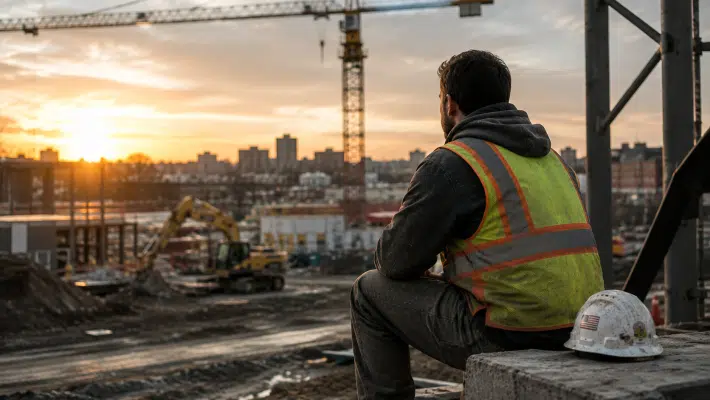
Construction worker sitting at a construction site at sunset.
Roughly 30% of construction workers fall into a high-risk category for mental health concerns, compared with 23% of the broader U.S. workforce.

What Good Looks Like: Five Areas That Actually Matter

The American Psychological Association identifies five intervention areas that define a psychologically healthy workplace. They translate directly to construction, and they give companies something more useful than a vague commitment to caring.

1. Health and safety, redefined

The single most effective shift a construction company can make is to stop treating mental health as an HR issue and start treating it as a safety issue.

This is not a semantic change. It changes who owns it, where it gets discussed, and how seriously it is taken. Safety already has structure in this industry: toolbox talks, stand-downs, incident reporting, supervisor accountability. Mental health belongs inside that existing system rather than in a separate wellness initiative that runs once a year.

Warning signs on a job site are specific and observable. Decreased productivity. Increased conflict between crew members. Near hits and incidents are rising. Decreased problem-solving ability. Increased tardiness and absenteeism. These are safety indicators as much as they are mental health indicators, and supervisors are already trained to watch for operational changes. They simply need to know what those changes can mean.

2. Supervisor training that goes beyond awareness

Foremen and crew leaders are the most important people in this entire equation. They see their crews every day. They notice when someone is off. And in most companies, they have no idea what to do about it.

Mental Health First Aid training gives supervisors two things: the ability to recognise early warning signs, and the confidence to start a conversation without making it worse. That second part matters more than people realise. Most supervisors do not stay silent because they do not care. They stay silent because they are afraid of saying the wrong thing.

Site briefing before a shift.
Mental health belongs inside the systems that already exist. Toolbox talks, stand-downs and supervisor check-ins are where this conversation is most likely to actually happen.

3. Access that people will actually use

Many construction companies technically offer employee assistance programs. The problem is that a significant share of workers do not know what they are, do not trust their confidentiality, or cannot easily access them.

Traditional support models rely on phone intake during business hours through non-clinical gatekeepers, with eligibility often tied to health plan enrolment. That structure misses project-based hires, seasonal craftworkers, and new employees. It also misses the foreman who would use a 24/7 chat from his truck but would never call HR.

Good access means all employees regardless of plan enrollment, available outside business hours, genuinely confidential, and communicated clearly enough that people know it exists before they need it.

4. Employee involvement and recognition

Culture is not built by policy documents. It is built by whether people feel their input matters and whether their work is seen.

Anonymous surveys, suggestion boxes and peer support programs give workers a way to raise concerns without exposure. Recognition, even informal, addresses one of the quieter drivers of poor mental health in this industry: the feeling of being interchangeable.

5. Work-life balance and realistic scheduling

Chronic fatigue is a direct precursor to mental distress. Extended hours, mandatory overtime, long drives and time away from family compound into something that no counselling program can fully offset.

Managing project schedules to allow adequate rest between shifts is not a soft benefit. It is a structural intervention, and often the one companies have the most direct control over.

Where to Start If You Have Nothing in Place

Not every company can implement all five areas at once. So here is a realistic sequence. Start with supervisor training, because it has the highest impact per dollar and requires no infrastructure. Add mental health to your existing toolbox talk rotation, because the mechanism already exists and costs nothing. Audit whether your current support offering is actually accessible to every worker, including project-based and seasonal staff. Then make sure leadership says something publicly, because 93% of construction industry leaders agree that addressing mental health is sound business practice, and workers need to hear that from the top rather than assume it. None of that requires a large budget. All of it requires a decision. The resources to do this already exist and most of them are free. Toolbox talks, supervisor training materials, stand-down guides and awareness campaigns built specifically for construction environments are all available at no cost. The Construction Industry Alliance for Suicide Prevention is the best place to begin. Their materials are built for this industry rather than adapted from a corporate wellness program, which matters more than it sounds.

Two workers walking the site together.
None of this requires a large budget. All of it requires a decision.

Why We're Writing This

Axis Interior Systems is a commercial flooring contractor. We are not mental health professionals and we would not pretend otherwise. But we have been building teams in this industry across Ohio, Kentucky and Indiana for over 30 years, and we believe companies our size have a responsibility to be part of this conversation rather than waiting for someone larger to lead it. The gap between the 69% who believe training helps and the 25% who provide it is not going to close through awareness campaigns. It closes one company at a time, through decisions that cost less than most people assume. If you or someone you work with is struggling, call or text 988 for free, confidential support, 24 hours a day. Statistics referenced in this article are drawn from industry research published by construction trade associations and workplace health organizations.

Want to Talk Through Your Team's Safety and Wellbeing Program?

If your construction or trade business is putting a mental health or safety initiative together and you'd like to compare notes with a contractor who's been building teams in this region for over 30 years, our team at Axis Interior Systems is ready to help.

Explore More Flooring Insights

Explore our flooring solutions, expert services, and industry insights to find the right system for your facility.

Copyright © 2026 IPRS Consultants. - All rights reserved.

Scroll to Top