Slip-and-fall incidents are one of the most common — and most preventable — liability issues in commercial buildings, and flooring is the single biggest factor a facility owner actually controls. Non slip flooring in the right locations, specified correctly for how wet a space actually gets, does more to reduce risk than any amount of signage or mopping schedule ever will.
At Axis Interior Systems, we’ve installed non-slip and moisture resistant flooring across restaurants, healthcare facilities, gyms, and commercial kitchens throughout Ohio, Kentucky, and Indiana for more than 30+ years in commercial flooring. This guide covers what actually makes flooring slip-resistant, the best flooring for wet areas by space type, and where facilities most often get this wrong.
Most commercial slip-and-fall claims trace back to a handful of predictable locations: entryways during bad weather, restrooms, kitchens, locker rooms, and any corridor near a spill-prone area. These spaces share one thing in common — water or other liquid regularly meets a hard floor surface, and standard flooring wasn’t built to stay safe under those conditions.
The fix isn’t just mopping more often. It’s specifying flooring that’s engineered to stay grippy even when wet, in the specific locations where wetness is a recurring condition rather than an occasional accident.
Slip resistance is measured, not just claimed. The relevant figure is the coefficient of friction (COF) — specifically the wet dynamic coefficient of friction, since that’s the condition that matters for wet-area flooring. Most safety standards recommend a wet COF of 0.42 or higher for areas where water contact is expected, though specific requirements vary by application and local code.
A few things drive that number on a real floor:
Surface texture. Textured, embossed, or aggregate-broadcast surfaces create more contact points for a shoe sole to grip, compared to a smooth, glossy finish that becomes dramatically more slippery the moment it’s wet.
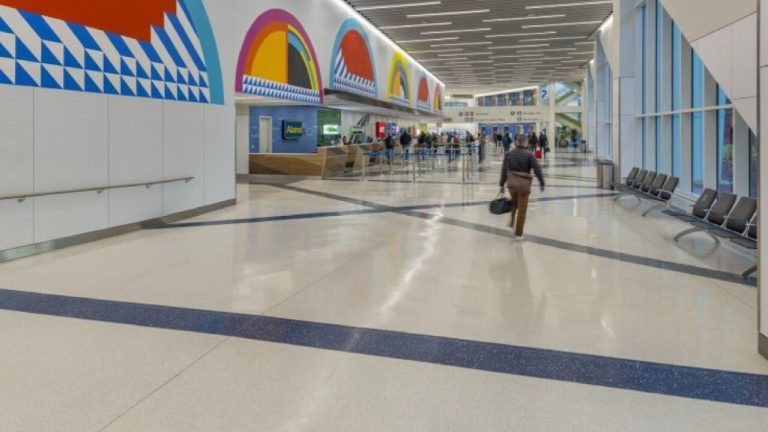
Material choice. Some materials are inherently more slip-resistant when wet than others, independent of texture — rubber and certain quarry tile finishes perform well by nature of the material itself, while polished materials like terrazzo or glossy porcelain need texture or a slip-resistant coating to perform safely in wet conditions.
Drainage and slope. In genuinely wet areas — commercial kitchens, locker room showers, pool decks — flooring that slopes to a drain reduces how long water sits on the surface at all, which matters as much as the material’s inherent grip.
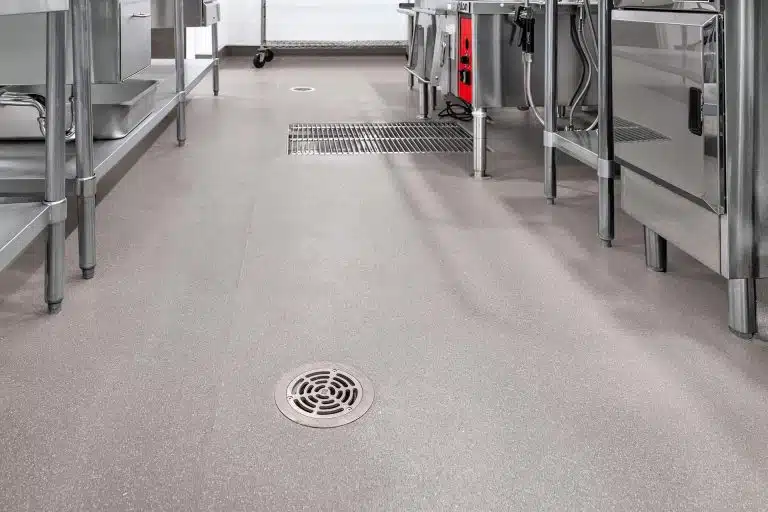
Commercial kitchens — Quarry tile or a resinous urethane mortar system with a broadcast aggregate for texture. Urethane mortar handles the thermal shock from boiling water and steam cleaning that standard resinous coatings can crack under, and it can be specified with a coved base sloped to drain.
Restrooms and locker rooms — Textured porcelain or ceramic tile, or a sheet vinyl system rated for wet areas. Grout lines on tile should be kept minimal and sealed, since grout itself can become a slip hazard when saturated.
Entryways — A properly sized walk-off matting system, ideally 15 to 20 feet of total run, captures the majority of tracked-in moisture before it reaches the main floor. This is one of the most cost-effective slip-prevention measures available and one of the most frequently skipped in budget-driven projects.
Gyms, pool decks, and locker rooms — Rubber flooring performs well here specifically because it stays grippy wet and doesn’t require a topical finish that can wear off over time.
Restaurant dining and back-of-house — Non slip flooring for restaurants typically means a slip-resistant LVT or sheet vinyl in dining areas, transitioning to quarry tile or resinous flooring behind the kitchen line where grease and water are a constant presence.
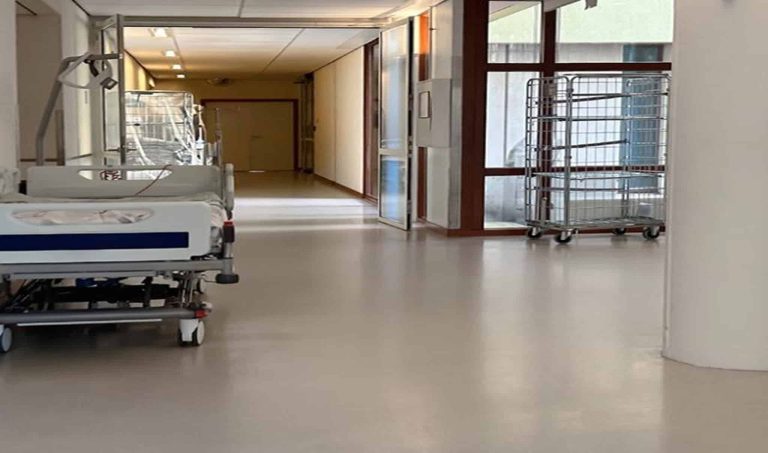
Healthcare corridors and clinical spaces — Homogeneous sheet vinyl with a textured, slip-resistant finish, which also satisfies the seamless, disinfectable requirements clinical spaces demand independently of slip resistance.

These two properties get conflated often, but they’re solving different problems. Moisture resistant flooring is about the material’s ability to tolerate water exposure without degrading, warping, or allowing moisture to reach the substrate underneath. Slip resistance is about surface grip once water is present on top.
A floor can be highly moisture resistant and still be dangerously slippery when wet — plenty of sealed, waterproof materials have smooth, glossy surfaces that become hazardous the moment water hits them. The best flooring for wet areas needs both properties working together: a material that tolerates water without failing, finished with a surface that stays grippy while it’s wet.
Specifying by moisture resistance alone. A waterproof floor that isn’t also slip-resistant hasn’t solved the actual liability problem — it’s just solved a different one.
Treating the whole building the same. A single flooring product carried through an entire facility, from dry offices to a wet kitchen, will underperform somewhere. Specify by zone based on actual wetness conditions, not by convenience of ordering one product for the whole project.
Skipping the walk-off system to save budget. It’s usually the smallest line item on a flooring estimate and one of the most effective slip-prevention measures in the entire building. Value-engineering it out shortens the effective life of every floor downstream, not just the entry.
Ignoring maintenance requirements. Some slip-resistant textured surfaces require specific cleaning methods to maintain their grip — an aggressive floor finish or wax applied incorrectly can actually fill in the texture that was providing the slip resistance in the first place.
Slip resistance isn’t purely a best-practice recommendation — it intersects with real regulatory expectations. The ADA doesn’t set a specific numeric slip-resistance requirement, but its guidance historically referenced a static coefficient of friction of 0.6 on level surfaces (0.8 on ramps) as a reasonable benchmark, and many architects and facility managers still design against that figure. OSHA’s general duty clause requires employers to maintain a workplace free of recognized hazards, which has been applied to slip-and-fall cases tied to inadequate flooring in wet work areas.
Neither of these functions as a flooring product certification exactly — there’s no single “ADA-approved” slip-resistant floor — but both underscore why documentation matters. OSHA’s walking-working surfaces standard requires floors to be kept clean, dry where feasible, and free of recognized hazards, and it’s been the basis for citations tied to inadequate flooring in wet work areas. Keeping a record of a product’s tested wet COF, along with maintenance logs showing the surface has been cared for as specified, is genuinely useful if a facility ever needs to demonstrate it took slip resistance seriously.
Find answers to common questions about hospital flooring, infection control, flooring materials, maintenance, durability, and how the right flooring solutions can help create a safer and more hygienic healthcare environment.
It depends on the space — quarry tile or urethane mortar for commercial kitchens, textured porcelain or rated sheet vinyl for restrooms, and rubber flooring for locker rooms and pool decks. The right answer is always specific to how wet the space gets and what’s on the floor.
No. Moisture resistant flooring tolerates water exposure without degrading; slip-resistant flooring stays grippy once water is on the surface. A wet-area floor typically needs both properties.
Quarry tile and resinous urethane mortar systems with a broadcast aggregate texture are the most common choices, both able to handle grease, water, and thermal shock from cleaning.
Yes, significantly. A properly sized entry matting system captures most tracked-in moisture and grit before it reaches interior flooring, which reduces the wet-floor conditions that cause the majority of entryway slip incidents.
It depends on the material and traffic level, but any textured or coated slip-resistant surface should be checked periodically to confirm the finish hasn’t been worn smooth or filled in by incorrect cleaning products — this varies enough by material that it’s worth confirming maintenance requirements at the time of installation.
Non-slip, moisture-resistant flooring solutions tailored to every space, backed by 30+ years of commercial experience.
Explore expert flooring solutions for healthcare facilities, from substrate preparation to durable flooring systems designed for active hospital environments.
Copyright © 2026 IPRS Consultants. - All rights reserved.